
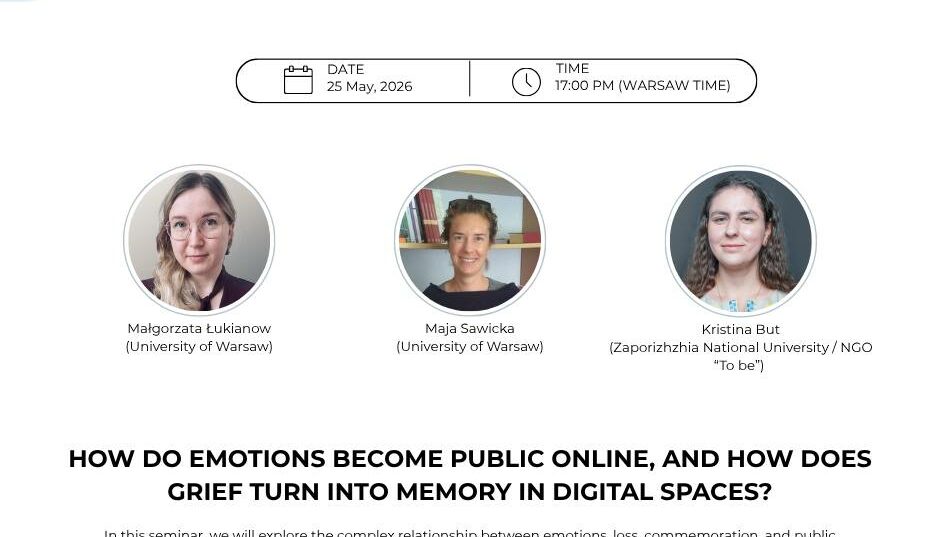
On May 25, the “Memory in the Making” team conducted the seminar “Feeling Memory: Emotions, Loss and Digital Commemoration”. The discussion was chaired by Małgorzata Łukianow (PhD, Faculty of Sociology, University of Warsaw). The speakers — Maja Sawicka (PhD, Faculty of Sociology, University of Warsaw) and Kristina But (PhD, Faculty of Journalism, Zaporizhzhia National University, Head of the NGO “To be”) — explored several key questions: what happens to emotions when they move from the private sphere into the digital one, and how digital commemoration has been functioning in Ukraine after February 2022.
A central idea running throughout the seminar was “sharing is caring” — the notion that discussing and sharing pain is itself an act of care. Commemoration, therefore, becomes not only an act of remembrance but also a form of collectively experiencing grief.
Maja Sawicka opened the discussion by focusing on the transition of emotions and feelings from the private sphere into the public one. She outlined three main aspects of the phenomenon: how we perceive emotions, how we communicate them, and how people manage their emotions online. Emotions are deeply individual, yet once they enter the digital space, they become mediatised and visible. Personal experiences of grief thus become part of a collective experience. Practices of commemoration, in this sense, create a shared language through which people can express and explain their feelings to others.
Kristina But focused on the psychological dimensions of loss, emphasising that experiences of loss — especially during wartime — vary greatly: from the death of a loved one to the loss of stability and safety. Ukrainians are currently facing multiple forms of loss and experiencing grief in different ways, including through practices of commemoration. The speaker shared examples of digital commemorative initiatives that have emerged after February 2022: memorial alleys with digital elements, virtual memory boards, digital memorials, and art exhibitions featuring interactive installations.
During the discussion, participants agreed that the tension between individual and collective expressions of grief can be visible even in digital spaces. This is why it is important to search for shared approaches that can make the experience of grief at least a little easier and help people find new meanings and sources of support.
The speakers also emphasised the importance of safety and self-awareness for researchers working with the topic of loss, noting the need to understand how other people’s grief affects researchers themselves. Participants further highlighted the importance of trauma-informed communication for those working with loss and remembrance: being aware of one’s role, maintaining transparency, and remembering that these are stories not only about pain and grief, but also about love.